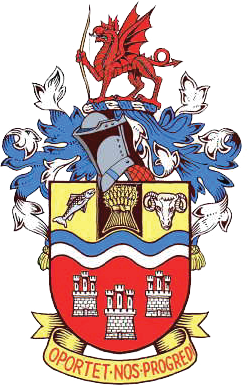
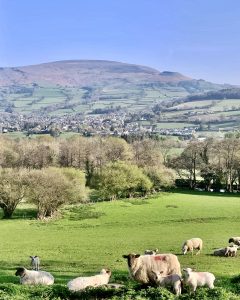
Crickhowell is a small town in the Brecon Beacons National Park. Situated in the Usk Valley, between Brecon and Abergavenny, Crickhowell is a highly attractive and distinct place, with many things to do and see. Lying at the foot of Table Mountain, and across the valley from the Llangattock Escarpment, Crickhowell has always captured the imagination of its visitors and residents. Visiting the town in 1806, Elizabeth Spence wrote of Crickhowell:
I have travelled through some of the most admired parts of England, and the most bold and romantic parts of Scotland, but I have never before beheld a scene so truly Arcadian as Crickhowell; and I almost expected to have seen shepherds and shepherdesses on the banks of its pastoral settings.[1]
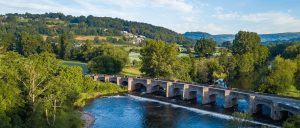
In the intervening two hundred and twenty years, Crickhowell has witnessed many changes, but Crugywel (the Welsh name for Crickhowell, which, in itself is derived from ‘Crug Hywel’ – Hywel’s Mound – which is thought to refer to the Iron Age fort on Table Mountain) would still be recognisable to Elizabeth. Of course, the A40 road and the annual duck race along the river Usk may prove to be causes of consternation for our nineteenth-century traveller, but the surrounding picturesque landscape will have retained all of its beauty, character and mystery for her.
Let us, however, place Elizabeth in the centre of town, as it is today. What would she see? If she stood by the Lucas Monument (erected in 1874 in honour of the local doctor, Henry Lucas), and looked down the high street she would observe a range of independent shops inhabiting much of the impressive Georgian buildings that contribute so much to Crickhowell’s attractiveness. There is the award-wining bookshop, Wales’ first zero waste shop, the family ran-department department store, a vintage antique shop, the local butcher shops (two within metres of each other), a bakery, the grocer, as well as an assortment of various bars, cafes, and hotels. Turning around, Elizabeth would then see the family-ran hardware shop, the outdoor adventure shop and, at last, a sight that would have been familiar to her: The Bear Hotel, which has been welcoming guests since 1432. All these businesses help to make Crickhowell the place it is today, and in 2018 the independent spirit of the Town was rewarded when it won the prestigious UK High Street of the Year competition.
After her experience of the bustling high street, Elizabeth might then prefer to partake in something slightly more cerebral and explore some local history and architecture. Walking down residential Bridge Street (which in Elizabeth’s time would have contained shops and inns), would, as the name of the street suggests, lead her to Crickhowell bridge, which, famously, contains twelve arches on one side and thirteen on the other. At one hundred and twenty metres it is said to be the longest stone bridge in Wales and has undergone numerous renovations since the original medieval wooden bridge was replaced by the current stone one in 1706.
Walking up New Road (which would, indeed, be a new experience for Elizabeth) leads to St Edmund’s Church, a beautiful building founded in the early fourteenth century (1303) by Lady Sybil Pauncefote of Crickhowell Castle, and a rare example of a church that has a spire on top of a tower. The church contains monuments of both Lady Sybil and her husband, Sir Grimbald, who some historians have argued was a member of the Knights Templar due to how he is represented here: dressed in chain mail with shield and crossed legged. There is a gruesome story that Sir Grimbald was captured on a crusade and imprisoned. Poor Sybil paid for his release by cutting off her right hand, hence on her monument she is depicted without hands.
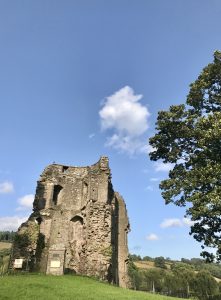
Having had her curiosity piqued by Lady Sybil and her husband, Elizabeth, could then walk east, up Tower Street, and visit Crickhowell Castle. The castle was originally a Norman motte and bailey structure, built by the Turberville family in the twelfth century. By all accounts it was refortified by Sir Grimbald in the mid-thirteenth century after he married Sybil Tuberville, daughter of Hugh Tuberville – a significant ally of King Edward who trained and led armed forces in the service of the King, against the Welsh. Militarily, the history of the castle bespeaks of the strategic importance of Crickhowell’s position near to the border of England. In 1400, fearing an uprising led by Owain Glyndŵr, Sir John Pauncefote, the great-grandson of Sir Grimbald, once again refortified the castle. It proved futile: in 1403 the castle was destroyed by Glyndŵr, and the stones from the ruins were used to build many of the buildings we see in town today.
Crickhowell, then, is a town where the past is very much entwined with the present. Standard Street, for example, is so named because this is where, apparently, King Henry V’s archers raised the King’s Standard on their way to Agincourt in 1415. The Clarence Hall is named after Queen Victoria’s grandson, Albert Victor, the Duke of Clarence and Avondale, who laid the foundation stone of the building in 1890. The Market Hall on the High Street was commissioned by Henry Somerset, 6th Duke of Beaufort in the 1830s. Of note, particularly in relation to the above story about Lady Sybil, is the fact that the Duke of Beaufort’s crest, which adorns the outside of the building, features a ‘Wyvern’ (a mythical dragon-type creature), with a severed hand in its mouth. Next time you walk past the building do have a look up. Some history has inevitably been lost over the years, however: the narrow street by the Church and the library called Silver Lane used to be called Printers Alley, indicating the type of business that went on there, in a similar way to how Mill Street still describes the type of activity that once occurred in that location.
Arriving in Crickhowell in 2023, Elizabeth can enjoy various events and cultural activities throughout the year. For example, if she wanted to explore the area further, in March, she could sign up for the Walking Festival and experience the Brecon Beacons and the Black Mountains in all their glorious splendour. In May, she could participate in the Choral Society’s Music Festival, or perhaps, for someone with such a poetic imagination as Elizabeth, she could submit a piece of art to the Oriel CRiC Gallery’s Open Studio event which takes place every May. In June, Crickhowell residents open-up their gardens to the public, whilst in August, Elizabeth could indulge her indie folk and avant-garde electronica predilections at Wales’s biggest music event, the Green Man festival. In October, Crickhowell welcomes its own literary festival with world-famous authors and workshops, and then, finally, in December, Christmas in Crickhowell sees the Christmas lights being turned on, Santa arriving in Crickhowell on his sleigh, and late-night shopping, allowing everyone to get those important last-minute gifts. As well as these events, Crickhowell also celebrates occasions of significant national importance, such as the recent Coronation of King Charles III.
Crickhowell Town Council is proud to be working for this community, with its rich mixture of history and culture. The Council is highly aware of Crickhowell’s past and works hard in the present to ensure that the ‘Arcadian’ idyll that Elizabeth Spence writes about, will be available to all, in Crickhowell’s future.
[1] Quoted in Robert Gant et al. ‘Crickhowell Through the Eyes of the Visitor 1740-1910’ (Crickhowell District Archive Centre, 2021).
See more at the Visit Crickhowell Website